If you've searched for uncensored AI prompts, you've probably encountered two very different things.
The first is the older world of AI jailbreaks: prompts designed to persuade a general-purpose chatbot to ignore or work around restrictions it normally follows.
The second is what the term increasingly means today: prompts used with AI systems that are intentionally designed to give users more freedom, including creative writing, marketing, storytelling, and AI image generation.
Those two ideas are related, but they are not the same.
An important distinction is that an uncensored prompt does not automatically make a censored AI model uncensored. A prompt is an instruction. The model and the platform processing that instruction determine what the system will actually allow.
In this guide, we'll explain how uncensored AI prompts evolved, what jailbreak prompts were trying to accomplish, what AI prompt generators do, and how to write better prompts for image generation and other creative applications.
We'll also explain why we built Open Spoken in the first place — because our own experience with mainstream AI tools made the problem very real.
What Is an Uncensored AI Prompt?
An uncensored AI prompt is simply a prompt intended to give an AI system more creative freedom over the requested output.
The word "uncensored" can be misleading, though.
It can refer to:
a prompt intended for an AI model with fewer content restrictions;
an AI model or platform designed for broader creative use;
an image prompt designed for unrestricted image-generation tools;
or, historically, a jailbreak prompt intended to manipulate a restricted model.
These are different things.
For example, asking an AI image generator to create a detailed cinematic scene is simply prompting. Whether the platform accepts the request depends on the model, its configuration, and the platform's rules.
Likewise, changing the wording of a prompt does not magically remove a model's underlying restrictions.
This is why the phrase "uncensored AI prompt" is better understood as part of a larger workflow:
idea → prompt → AI model → output
The prompt controls the instruction. The model controls how that instruction is interpreted.
Why Did People Start Searching for Uncensored Prompts?
When mainstream generative AI became popular, users quickly discovered that different systems had very different boundaries.
A request that worked on one model could be rejected by another.
For people working in sensitive industries or simply exploring forms of creative writing that mainstream assistants were uncomfortable handling, this could become frustrating.
Some users began experimenting with what became known as jailbreak prompts.
The goal was generally to manipulate the model into behaving differently from its intended configuration — for example, by attempting to make it follow a fictional persona, reinterpret the user's request, or disregard previous instructions.
From a technical perspective, jailbreaks are related to the broader concept of prompt injection. OWASP describes prompt injection as a vulnerability in which crafted inputs alter an LLM's intended behavior; it identifies jailbreaking as a form of prompt injection in which inputs attempt to make a model disregard its safety protocols.
This is important context, because it explains where much of the early interest in "uncensored prompts" came from.
But it also explains why relying on jailbreaks is increasingly unreliable.
Jailbreaks and Uncensored AI Are Not the Same Thing
A jailbreak attempts to change the behavior of a system that was not designed to respond to a particular request.
An uncensored or less-restricted AI platform starts from a different premise: the platform itself is designed to support a broader range of legitimate creative use cases.
That difference matters.
A jailbreak is essentially trying to find a weakness in the interaction between the user and the model.
A purpose-built AI platform instead makes its product decisions up front: which use cases it supports, which models it uses, what controls it applies, and which requests remain prohibited.
There is no guarantee that a particular jailbreak will work. Models change, safety systems change, and techniques that worked against one system may fail against another.
OWASP's current guidance also treats prompt injection and jailbreak resistance as an ongoing security problem rather than something that can be solved by one magic prompt.
That's why today's search for "uncensored AI" increasingly leads users toward purpose-built tools rather than simply collections of jailbreak prompts.
What Is an AI Prompt Generator?
There is another meaning of "AI prompt generator" that is particularly useful for image creation.
A prompt generator doesn't necessarily generate the final image.
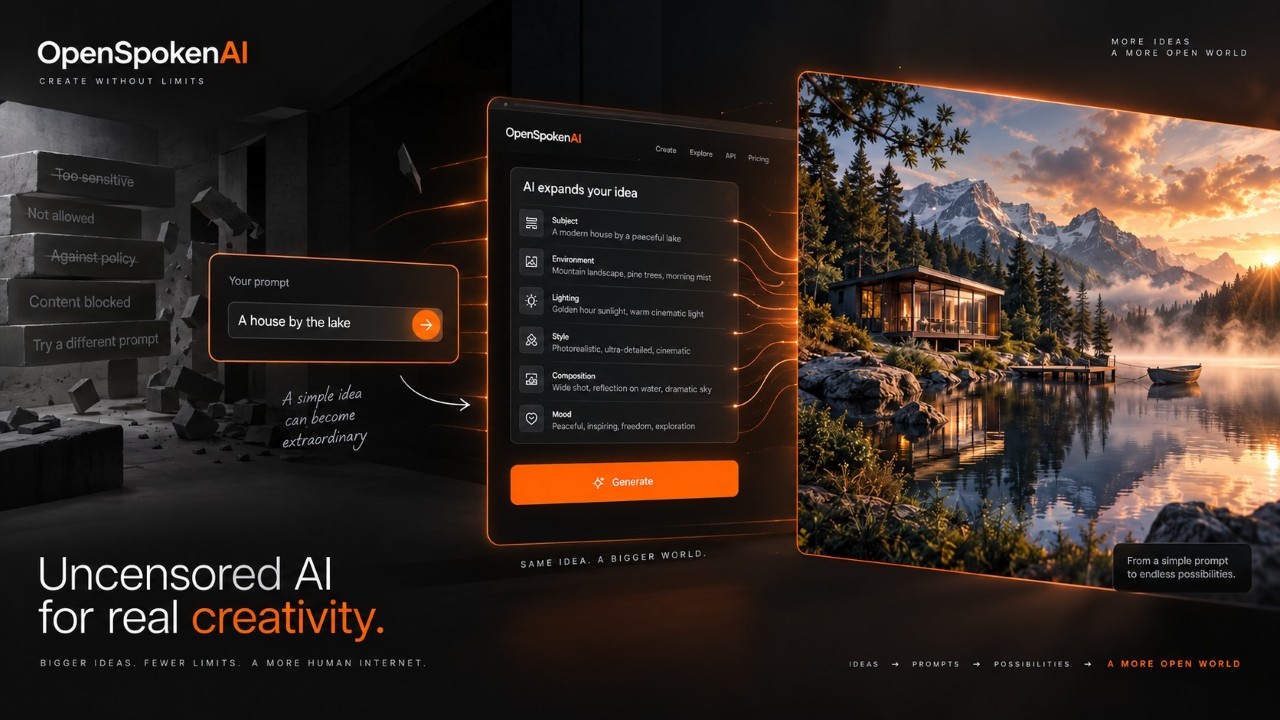
Instead, it helps transform a simple idea into a more detailed prompt that can then be given to an image-generation model.
The workflow looks like this:
Your idea → AI prompt generator → detailed prompt → image generator → final image
For example, you might start with:
A futuristic city at night with a woman standing in the street.
A prompt generator could help expand that idea by adding details about the environment, lighting, composition, camera perspective, atmosphere, clothing, color palette, and visual style.
The final prompt can then be used with an image generator.
This approach is useful for people who know what they want to see but don't necessarily know how to describe it in the language that an image model responds to best.
Platforms such as Perchance provide dedicated AI prompt-generation tools, including an Unrestricted AI Image Prompt Generator and other prompt-writing utilities.
The important point is that a prompt generator and an image generator are two different stages of the creative process.
Why We Built Open Spoken
The reason Open Spoken exists is much more practical than the current "uncensored AI" trend might suggest.
In 2023, I was running an online business selling intimate products, including intimate gel.
I wanted to use large language models for completely ordinary business tasks.
I needed help writing product descriptions.
I wanted instructions explaining how products should be used.
I wanted to create SEO articles and marketing content.
The problem was that some mainstream AI systems refused to help with parts of this work simply because of the subject matter.
For a business operating in an adult-oriented industry, that created a genuine productivity problem.
The issue wasn't that I wanted an AI to "break the rules."
I wanted an AI that could help with legitimate business work without treating the entire subject matter as something that couldn't be discussed.
Then I started seeing other people in adult-oriented businesses talking about exactly the same problem on forums.
I posted about my own experience.
Within minutes, dozens of people had reacted and joined the discussion. At the time, it became one of the most commented posts I had published.
That was the signal.
There were clearly other people who wanted AI tools for use cases that mainstream platforms weren't interested in serving.
Open Spoken was launched toward the end of 2023.
The product has since evolved, but that original problem remains part of why it exists.
From Text Generation to AI Image Generation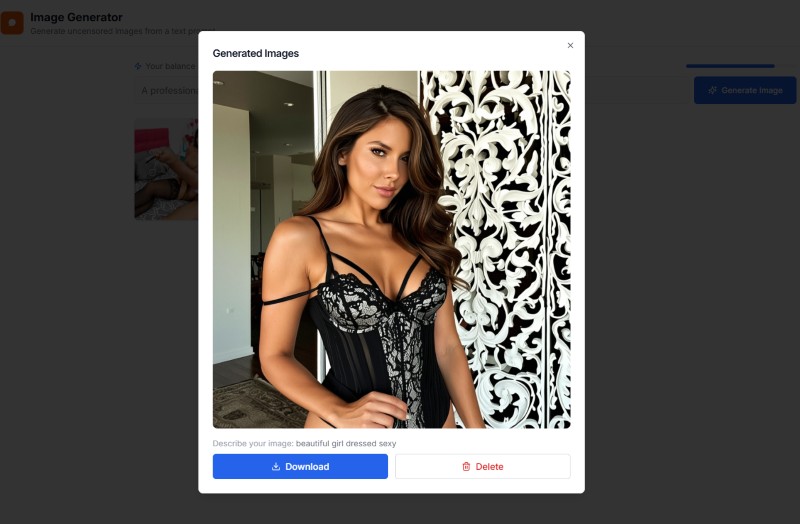
The original problem was primarily about text.
But users wanted more.
In 2024, we added AI image generation following requests from users who wanted the same kind of creative freedom for visual content.
Today, Open Spoken presents AI image generation alongside its text-generation products, including image generation for marketing and creative workflows.
That creates an important distinction between two workflows.
Workflow 1: Use a prompt generator
You start with an idea, use a separate tool to construct a detailed prompt, and then send that prompt to an image generator.
Idea → prompt generator → prompt → image generator → image
This is useful if you enjoy controlling the prompt itself.
Workflow 2: Describe the image directly
You simply explain what you want to create and let the AI handle the prompt construction and generation.
Idea → AI → image
This is useful if your priority is speed and experimentation rather than manually constructing every part of the prompt.
Neither workflow is inherently correct.
Some people want complete control over the prompt.
Others simply want to describe an idea and see what the AI creates.
What Does "Uncensored" Actually Mean?
This is probably the most important distinction in the entire subject.
Uncensored does not mean "anything is allowed."
An AI platform can choose to support categories of content that mainstream assistants restrict while still maintaining boundaries around illegal or abusive content.
That distinction matters because "uncensored" is often interpreted as "no rules."
That's not what we mean by it.
For Open Spoken, the goal has been to provide more freedom for legitimate creative and business use cases — particularly areas that general-purpose assistants may restrict — rather than to create a tool for illegal activity.
The platform has also evolved as we have seen how people actually use it.
In 2026, we introduced additional detection for illegal content after seeing a minority of users attempt to generate prohibited material, including content involving minors.
Our position on that is straightforward:
Illegal content is not acceptable.
Attempts to abuse the platform can result in warnings and account sanctions, including bans for repeat violations.
That doesn't contradict the idea of an uncensored AI.
It defines what we mean by it.
More creative freedom does not mean freedom from the law.
Uncensored AI Prompts vs. Uncensored AI Models
It's worth separating these concepts one more time.
Term What it means
Uncensored AI prompt: A prompt intended for a system that allows broader creative output
Jailbreak prompt: An input designed to manipulate a restricted system into changing its behavior
AI prompt generator: A tool that helps turn an idea into a more detailed prompt
Uncensored AI model: A model configured or trained for broader content use
Uncensored AI platform: A complete product built around a broader set of supported use cases
AI image generator: A system that turns text or other inputs into images
Understanding these differences makes the whole topic much less confusing.
If a model refuses a request, endlessly modifying the wording isn't necessarily the right solution.
Sometimes the better solution is simply to use a platform designed for the type of creative work you're trying to do.
Can an Uncensored Prompt Bypass AI Censorship?
Historically, some jailbreak techniques have been able to manipulate the behavior of particular AI systems.
But there is no universal "magic prompt" that permanently removes the restrictions of every AI model.
Jailbreaking is an ongoing technical arms race: model behavior, safety mechanisms, and attack techniques all change over time. OWASP continues to classify prompt injection as a significant LLM security issue and recommends layered mitigations including input/output filtering, constrained model behavior, adversarial testing, and human oversight for high-risk actions.
So if your objective is simply to create a particular kind of legitimate content, using an AI platform intended for that use case is generally a more predictable workflow than relying on an old jailbreak prompt you found online.
Is Uncensored AI Legal?
"Uncensored" describes the level of restriction applied by an AI service. It does not determine whether a particular use is legal.
The legality of generated content depends on what is being generated, how it is used, and the laws that apply to the user and the service.
This is especially important for image generation and adult-oriented applications.
A platform allowing more creative freedom should not be interpreted as permission to generate illegal content.
Users remain responsible for using AI systems lawfully.
What Makes a Good AI Prompt?
The best prompt isn't necessarily the longest one.
A useful prompt usually communicates the things that actually matter to the desired result.
A simple framework is:
Subject + context + style + composition + lighting + important details
For example:
A vintage motorcycle outside a roadside diner, desert highway in the background, cinematic photography, golden-hour sunlight, wide composition, subtle film grain.
You can then iterate.
If the motorcycle is wrong, change the description.
If the environment is wrong, add more context.
If the image feels too bright, change the lighting.
If the composition isn't right, specify the framing.
Prompting is not about finding one secret sentence.
It's about communicating an idea clearly enough for the model to turn it into something useful.
The Future of Uncensored AI Prompts
The meaning of "uncensored AI prompt" has changed considerably.
It started as part of a culture of experimentation around general-purpose chatbots and jailbreaks.
Today, the search increasingly overlaps with a much broader ecosystem of AI models, image generators, prompt generators, creative writing tools, and specialized platforms.
That shift makes sense.
People don't necessarily want to "break" an AI system.
Often, they simply want a system that understands the use case they have.
That's ultimately why we built Open Spoken.
The goal wasn't to create a collection of tricks for defeating AI safeguards.
It was to build AI tools for people whose legitimate work, businesses, stories, and creative projects didn't always fit inside the narrower boundaries of mainstream assistants.
And as the technology evolves, that distinction will remain important:
uncensored should mean more creative freedom — not a license for illegal content.
Frequently Asked QuestionsWhat is an uncensored AI prompt?
An uncensored AI prompt is a prompt intended to produce content with fewer unnecessary restrictions, typically when used with an AI model or platform designed to support broader creative use cases.
What is the difference between an uncensored prompt and a jailbreak?
A jailbreak attempts to manipulate a restricted AI system into changing behavior it was designed to maintain. An uncensored prompt is simply an instruction used with a system that already supports a broader range of content.
What is an AI prompt generator?
An AI prompt generator transforms a basic idea into a more detailed prompt that can be used with another AI system, particularly image-generation models.
Can AI prompt generators create images?
Usually, a prompt generator and an image generator are separate tools. A prompt generator creates the instructions; an image generator uses those instructions to create the image. Some platforms combine both functions.
Do longer prompts create better AI images?
Not necessarily. More detail can help when the detail is relevant, but adding unnecessary words can make a prompt less clear. Start with the important elements and iterate based on the result.
Is uncensored AI the same as an AI with no rules?
No. A platform can support broader creative use cases while still prohibiting illegal or abusive content.
Can I use Open Spoken for AI image generation?
Open Spoken currently offers AI image generation alongside its text-generation tools. The available image features depend on the product and plan.
Final takeaway
If you're looking for uncensored AI prompts, don't assume that the answer is a secret jailbreak prompt.
The more useful question is:
What do you actually want the AI to create, and which tool is designed to support that use case?
For simple image generation, describe your subject, environment, style, lighting, and composition, then iterate.
If you want more control, use a dedicated prompt generator before sending the prompt to an image model.
And if you're repeatedly fighting a general-purpose AI's restrictions for legitimate creative or business work, consider using a platform built specifically for broader creative freedom instead.
That's the problem Open Spoken was created to solve.